
A self-sustaining modular habitat for human settlement and food production on Mars.
Eyes of Eden is a Mars surface habitat designed to establish permanent human presence on the Red Planet. The project integrates pressurised domed modules with closed-loop ecological life support systems, enabling long-duration missions with in-situ food production and resource autonomy.
The modular design allows for incremental expansion and adaptation to varied Martian terrain, while centralised power and life support systems provide resilience and cross-module redundancy for operational continuity.
| Overview | |
|---|---|
| Inflatable modules | 19, across 4 Starship launches |
| Module envelope | 8 m diameter × 17 m height |
| Max crew capacity | 15 |
| Operational lifespan | 20+ years |
| Site | Jezero Crater, Mars |
| Hybrid life support (CELSS & ECLSS) | |
| BLSS pods per individual | 10 |
| Daily production target | 2,500 kcal / person |
Eyes of Eden achieves sustainable human settlement on Mars by solving three critical challenges: safe long-term habitation in an extreme environment, reliable food production independent of Earth resupply, and efficient resource cycling to minimise dependence on imported consumables.
The project prioritises crew psychology and quality of life through natural lighting design, interior plant integration, and modular social spaces that mitigate isolation during multi-year missions.
The habitat name reflects both purpose — providing refuge and hope on an alien world — and function: the integrated greenhouses serve as psychological anchors and reminders of Earth's living systems adapted to an extreme Martian context.
The regular crew of 10 comprises 1 Mission Commander, 2 Doctors, 2 Engineers, 1 EVA Specialist and 4 scientists — an Astrogeologist, Biologist, Chemist and Astrophysicist. The habitat also accommodates an expanded complement of 3–5 business guests, including space tourists and representatives of private space companies.
Modularity allows the settlement to evolve with changing mission requirements, adding research, storage, recreational or medical facilities without disrupting existing operations.

The habitat is sited at Jezero Crater, selected for three reasons: the crater was once a giant lake, leaving soil rich in minerals and microbial fossils; the terrain was proven safe as a landing site by the Perseverance rover in 2021; and the ancient delta geology offers accessible subsurface resources for in-situ resource utilisation.
The deployment timeline spans three stages: initial infrastructure in December 2030 (Stage 1), habitat expansion in April 2033 (Stage 3), and full operational configuration in June 2035 (Stage 4).

Natural lighting is integrated into each module through skylights positioned at optimal angles to provide consistent illumination while minimising direct radiation exposure. The launch schedule spans four SpaceX Starship missions, each adding habitation and life-support capacity: December 2030 (Stage 1), April 2033 (Stage 3) and June 2035 (Stage 4).


Each habitat unit is an inflatable module constrained by SpaceX Starship payload dimensions — 8 m diameter and 17 m height. 19 modules are deployed across 4 Starship launches, arranged in a radial cluster that centralises utility connections for power, water and atmosphere management while minimising the exposed surface perimeter.


Each CELSS complex integrates multiple bio-regenerative life support system (BLSS) pods targeting a minimum of 2,500 kcal per individual per day, based on Wheeler (2003). The system employs four nutrient delivery methods — aeroponics, hydroponics, NFT (nutrient film technique) and porous tubes — enabling high-yield crop production across varied plant species with continuous CO₂ capture from crew respiration.


Complete documentation and design development.
- Wheeler (2012)Cited in EOE-05.1
Cross-referenced sheets
-
 Designing Biological Autonomy for Orbital Habitats – ICELSS
ICELSS: an inflatable controlled ecological life support system for orbital habitats, linking crop yield, spatial configuration and crew experience.
Designing Biological Autonomy for Orbital Habitats – ICELSS
ICELSS: an inflatable controlled ecological life support system for orbital habitats, linking crop yield, spatial configuration and crew experience.
-
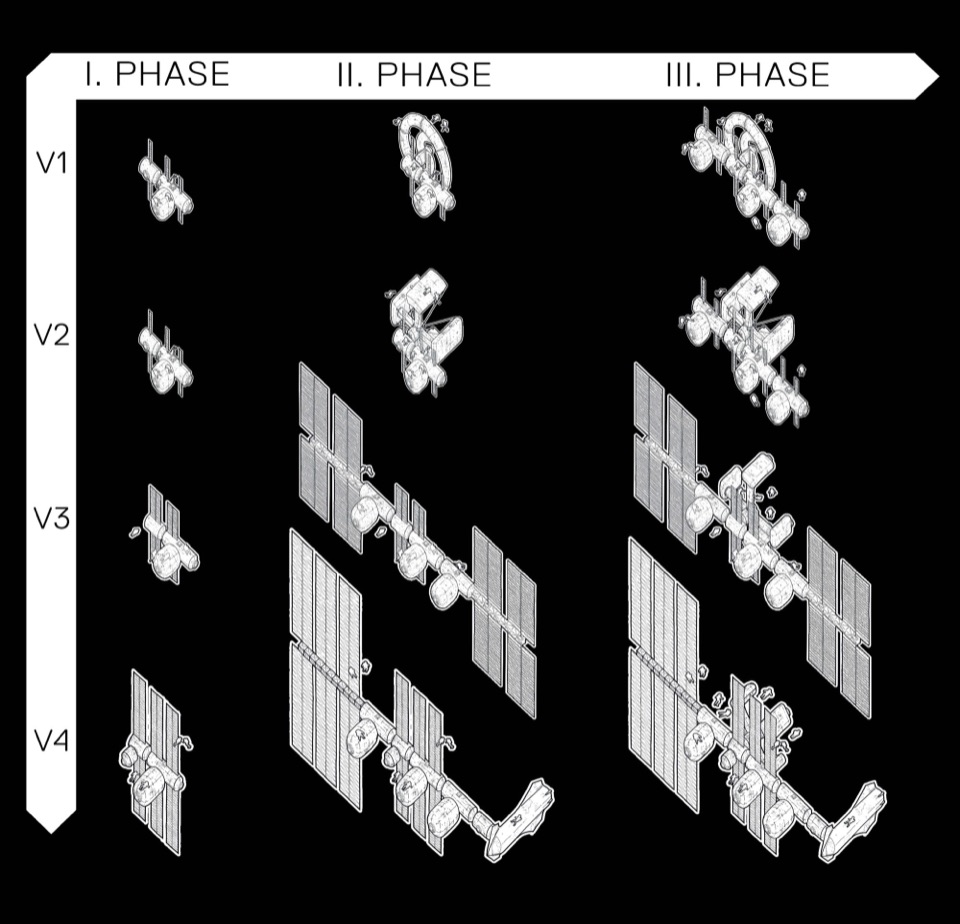 Promethea Station
A successor to the ISS, built to validate artificial gravity and closed-loop life support.
Promethea Station
A successor to the ISS, built to validate artificial gravity and closed-loop life support.
-
 Promethea Station — 24th IAA Humans in Space Symposium
A presentation of Promethea Station at the 24th IAA Humans in Space Symposium.
Promethea Station — 24th IAA Humans in Space Symposium
A presentation of Promethea Station at the 24th IAA Humans in Space Symposium.