
A successor to the ISS, built to validate artificial gravity and closed-loop life support.
Promethea Station is a modular platform in low Earth orbit designed to bridge the gap between the ISS and the demands of long-duration deep-space missions. An AG habitat rotates to generate Martian-equivalent gravity while the backbone runs a fully closed biological life support system — the two technologies most critical to a crewed Mars transit.
A commercial sector accommodates short-stay visitors, generating the revenue that sustains the research mission. The station reaches its final configuration after six Starship launches across four vehicle variants and three assembly phases.
| General | |
|---|---|
| Capacity | 12 — 8 crew, 4 tourists |
| Starship launches | 6 |
| Design life | 20 years minimum |
| Space Crusader habitation module | |
| Rotation radius | 10.8 m |
| Floor gravity | 0.38 g |
| Spin rate | 5.612 rpm |
| ICELSS closed-loop life support | |
| Growing area per person | 40 m² |
| Caloric target | 2,500 kcal / person / day |
| Crew served per unit | 4 |
Promethea Station addresses the two most critical unknowns of human deep-space travel: what sustained partial gravity does to the body over years, and whether biological systems can replace resupply chains entirely.
The AG habitat rotates at 5.6 rpm to simulate 0.38 g — equivalent to Martian surface gravity — so the station becomes a long-duration testbed for crew physiology before any Mars transit is attempted. The four ICELSS greenhouse modules provide a fully closed loop of oxygen, water and food per crew unit, eliminating dependence on Earth resupply for those basic necessities.
The commercial sector is not decorative. Four short-stay tourism berths generate the operational funding that makes the research mission financially viable — a deliberate design constraint that shaped the station's modular structure.
Promethea is designed to remain operational for a minimum of 20 years, with modules replaceable on-orbit via Starship cargo flights. It is intended as the operational predecessor to any permanent Martian habitat: every system it tests is a system that Mars will require.
Four vehicle variants (V1–V4) were derived from the station, illustrated across three assembly phases. Each phase adds structural, habitation and life-support capacity. Columns represent assembly phases; rows represent vehicle variants carrying progressively larger payloads.

The final configuration shows the four Space Crusader habitation arms extending symmetrically from the central hub. The ICELSS modules are separate inflatable volumes connected to the microgravity backbone. The large solar array truss provides power for the full station, and the backbone itself allows zero-g research.

Two distinct zones serve different gravity levels and user groups. The outer ring of Space Crusader modules provides Martian gravity, while the backbone provides a microgravity environment.


The Space Crusader is the primary habitation unit. Four modules extend from the central hub in a cross configuration and rotate together at 5.6 rpm, generating 0.38 g at the habitat floor through centrifugal force. The station accommodates 12 individuals across 4 modules — 8 permanent crew separated in 2 modules and 4 tourists in the remaining 2.
The cross-shaped plan allows four equal arms to extend radially, creating a balanced rotation system that takes advantage of the resulting Coriolis force. The modules are arranged parallel to the rotational axis to favour movement along it and mitigate the effect of Coriolis force on crew motion.

Dimensions
- Rotation radius
- 10.8 m
- Overall span
- 21.6 m
- Floor gravity
- 0.38 g
- Spin rate
- 5.612 rpm


The ICELSS — Inflatable Controlled Ecological Life Support System — consists of separate inflatable modules connected to the microgravity backbone. The units complete the biological loop: plants absorb the CO₂ and water produced by the crew, return oxygen, and yield food. Waste is preferably composted back into the growing medium.
The toroidal geometry creates a continuous growing surface. 40 m² of cultivated area per person is achieved through aeroponics and felt/NFT harvesting units, and autonomous robotic harvesting operates independently of crew schedules.


| Daily caloric target | 2,500 kcal / person |
| Coverage per unit | 4 crew members |
| Aeroponic area | 4.421 m² / unit |
| Felt / NFT area | 1.341 m² / unit |
| Total per person | 40 m² |
| Harvesting | Autonomous robotic, 24-hour cycle |
| Primary crops | Wheat, soy, potato, lettuce, tomato |


Living at 0.38 g in a rotating habitat is unlike any prior human spaceflight experience. The interior is designed to make this condition legible: curved floors follow the rotation radius, sightlines extend into the greenhouse, and natural light cycles are simulated to support circadian rhythm.


Architect of ISS: Architecture Beyond Earth
There is an overwhelming argument that successor stations to the International Space Station should have a reduced gravity research capability to begin to fill the total knowledge gap on the effects of Martian gravity on the human body. None of the designs developed by the aerospace industry so far appears to have this feature. It is good to see a rotating cruciform module structure added to this microgravity design that otherwise has much in common with the International Space Station but with the transverse truss spine replaced by a line of modules. This design shows that it would be physically quite possible to add a reduced gravity research capability to a conventional space station design. The tether system adds a level of complication and perhaps tensioned struts would work as well.
This design has an important analysis of ecological life support system requirements. The ability of one 7-metre diameter inflatable module to service the life support needs of 4 occupants is a valuable deduction from the calculations and given plant performance data. This design is also well supported by literature references, solar panel and radiator calculations and the use of Ted Hall's SpinCalc online calculator to confirm the torus parameters.
A booklet chapter by Beliz Bayraktar, Christopher Egg and Luka Pejic, from the HB2 Orbital Shift studio.
Cross-referenced sheets
-
 Promethea Station — 24th IAA Humans in Space Symposium
A presentation of Promethea Station at the 24th IAA Humans in Space Symposium.
Promethea Station — 24th IAA Humans in Space Symposium
A presentation of Promethea Station at the 24th IAA Humans in Space Symposium.
-
 Designing Biological Autonomy for Orbital Habitats – ICELSS
ICELSS: an inflatable controlled ecological life support system for orbital habitats, linking crop yield, spatial configuration and crew experience.
Designing Biological Autonomy for Orbital Habitats – ICELSS
ICELSS: an inflatable controlled ecological life support system for orbital habitats, linking crop yield, spatial configuration and crew experience.
-
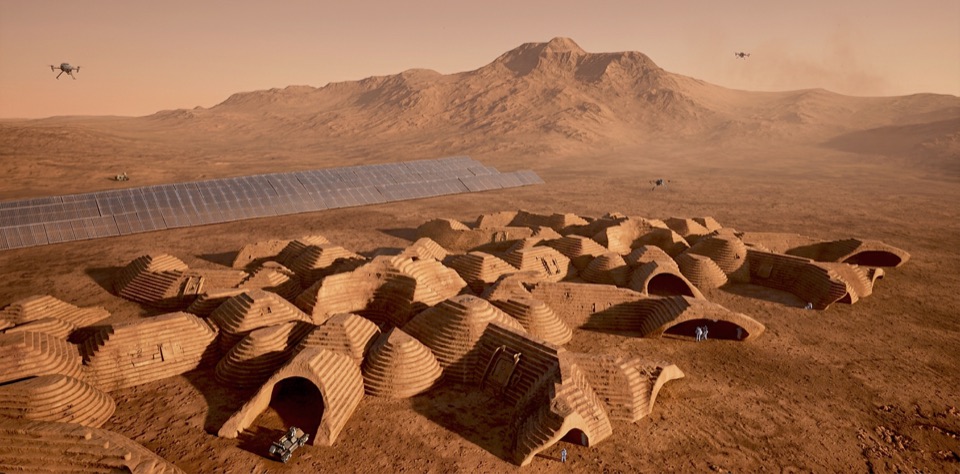 Eyes of Eden
A self-sustaining modular habitat for human settlement and food production on Mars.
Eyes of Eden
A self-sustaining modular habitat for human settlement and food production on Mars.