
A multi-tenant orbital industrial park for debris recycling and in-space manufacturing.
The primary objective of ARACHNEA is to treat orbital debris not as waste to be removed, but as material already in orbit and worth using.
At 800km altitude, Low Earth Orbit (LEO) holds the largest standing concentration of debris of any shell. As commercial activity in orbit grows, so does the risk posed by material already circling above it.
The station captures, sorts, and melts debris into feedstock, manufacturing it back into structure on-orbit. This allows the construction of components too large or fragile to survive an Earth launch, while offering debris removal itself as a commercial service.
A secondary aim of the project is to establish the economic and legal framework, split between remediation and material credits, needed to make debris recycling a viable market rather than a subsidised cleanup effort.
| General | |
|---|---|
| Topic | Orbital debris recycling and in-space manufacturing |
| Location | Low Earth orbit (LEO) |
| Altitude | 800 km |
| Crew members | 12, 3-month rotation |
| Crew | |
| Command | 2 |
| Systems | 3 |
| Manufacturing | 4 |
| Robotics | 1 |
| Mechanical engineering | 1 |
| Physician | 1 |

A multi-tenant orbital industrial park for debris recycling and in-space manufacturing
At an altitude of 800km, Low Earth Orbit (LEO) holds the largest concentration of orbital debris. The project proposes to treat the debris not as waste to be removed, but as material that is already in orbit and worth using.
Branches are leased to separate operators, whose autonomous catcher craft retrieve debris. The material is sorted by composition, melted into feedstock, and manufactured back into usable structure.
The station has 2 aims:
- Debris removal sold as a service
- Manufacturing structures that cannot be launched from Earth
Keywords: debris, in-space manufacturing, crew operations, orbital logistics
Why 800km?
Driven by feedstock availability and permanence. This altitude coincides with the approximate peak in LEO debris population (Hayashi et al., 2025), and is where the most valuable targets sit, being rocket bodies most critical for removal in a cluster between 750 and 1000km (Anselmo & Pardini, 2016).
Unlike 400km, where atmospheric drag pulls debris downward and constituent masses grow tenfold to 2050, the 800km population remains stable across 2016–2050 (Hayashi et al., 2025).
Novelty in ARACHNEA’s approach
Architecturally, ARACHNEA is conceived as an orbital industrial park. Its form follows the path of the material: debris enters at the capture end, and is sorted, melted, and manufactured back into structure as it travels the central spine. Habitation is present to service and monitor the process rather than to be ARACHNEA’s purpose.
The multi-tenant approach is expressed directly in the built form. The station is partitioned into branches that separate operators lease and feed with their own catcher craft, all delivering into a shared material pool. Circulation between facilities is handled by a contactless electromagnetic carrier, the Glider module, using the primary structure as a path with no wheels or friction.
The station is designed to grow by self-similar repetition of its clusters along the spine, ultimately building its own extensions from the feedstock it produces, closing the loop between what it recycles and what it becomes.
ARACHNEA’s contribution is not the recycling of orbital debris, which is a concept which is already well established from Matas’s ORDER station (2020). What is new is the economic architecture built around it. ARACHNEA’s approach reframes debris from waste-to-dispose or metal-to-sell into a shared orbital material stock, and constructs a two-product financial mechanism that makes both the manufacturing and the remediation independently bankable.

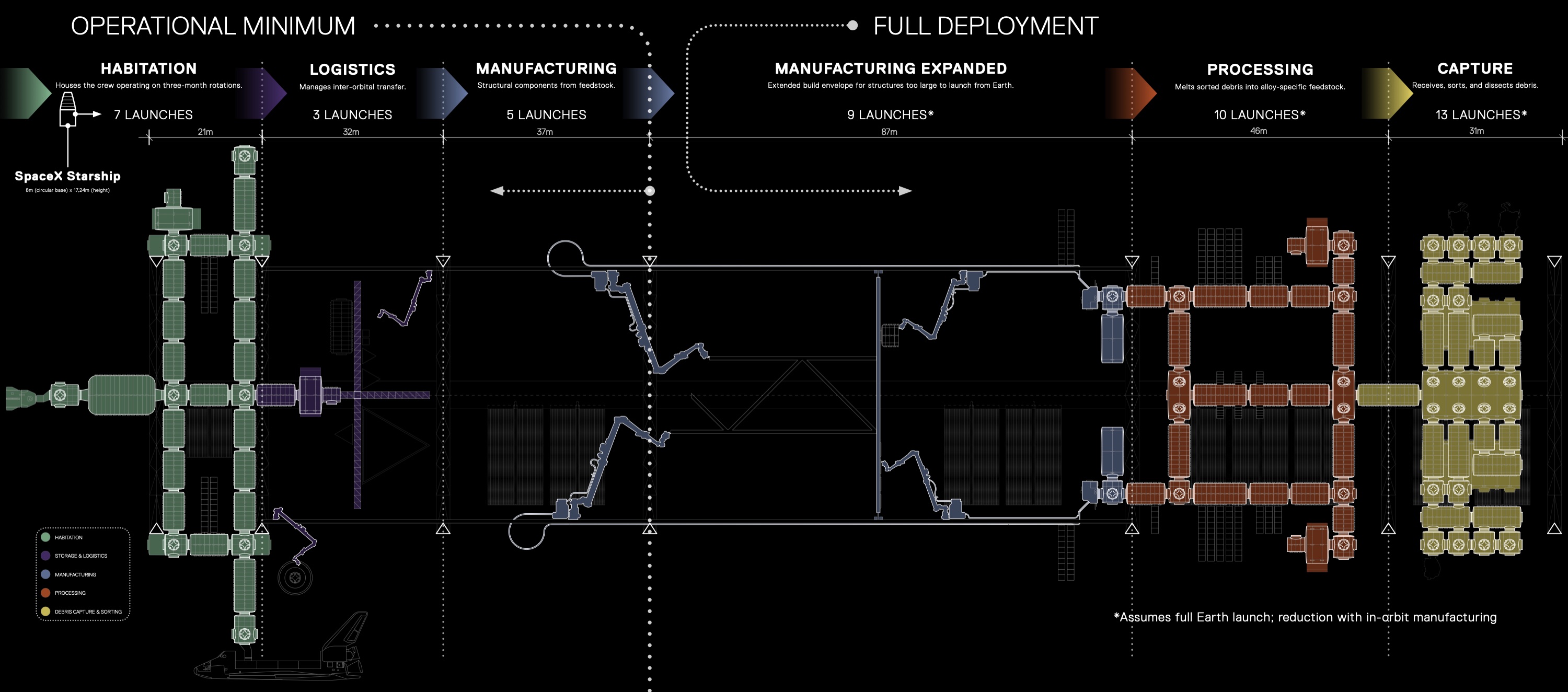
| Operational minimum | |
|---|---|
| Habitation — houses the crew operating on three-month rotations | 21 m · 7 launches |
| Logistics — manages inter-orbital transfer | 32 m · 3 launches |
| Manufacturing — structural components from feedstock | 37 m · 5 launches |
| Full deployment | |
| Manufacturing expanded — extended build envelope for structures too large to launch from Earth | 87 m · 9 launches* |
| Processing — melts sorted debris into alloy-specific feedstock | 46 m · 10 launches* |
| Capture — receives, sorts, and dissects debris | 31 m · 13 launches* |
| Launch vehicle | |
| SpaceX Starship | 8 m circular base × 17.24 m height |
*Assumes full Earth launch; reduction with in-orbit manufacturing
Operational minimum
I. Functional use case and operations
At this tier ARACHNEA is a crewed orbital factory, not yet a full recycler. Twelve crew on three-month rotations live in the habitation facility and move between structures on the glider module running the twin-lane spine. The logistics tier manages inter-orbital transfer and hosts the multi-tenant accounting. Manufacturing produces large structural components, but with no capture or processing done beforehand, with the feedstock being launched from Earth as wire.
II. Maintenance, repair, replacement
Maintenance is deliberately conventional. The mechanical engineer and robotics specialist, together with the glider module, cover inspection and intervention, with EVA for anything out of reach. Every module berths through a standardised interface, so a failed unit is swapped whole rather than repaired in place. The one early self-repair capability is provided by the manufacturing facility: it can print non-critical structural spares.
III. Expansion strategies
Expansion at operational minimum is simply the route to full deployment. Growth means bolting processing and capture onto the existing station and turning an orbital factory into a self-supplying recycling park. Envisioned rocket launches after the establishment of the operational minimum are estimated, since in-orbit manufacturing provides a potential reduction of launch necessity.
Full deployment
I. Functional use case and operations
The loop closes and both aims of ARACHNEA go live. Tenants’ autonomous catchers retrieve debris and dock at the catcher interface nodes. Fragments pass through the sorting array for compositional identification, afterwards being routed through the compositional sorting array to the raw material deposit. Processing melts the sorted streams into alloy-specific feedstock by electromagnetic levitation with a recirculation loop for off-spec material. Manufacturing runs on recovered material, and the same captured stage yields both economic products explained later in the accounting model.
II. Maintenance, repair, replacement
The full deployment makes structure from scrap, providing its own spares from recovered feedstock. The limit is honest and designed around: recycled melt loses volatile alloying elements and carries porosity, meaning the process verifies composition and tunes beam parameters before deposition, and the recirculation loop re-melts off-spec material rather than scrapping it, making recovered feedstock fit for defect-tolerant parts.
III. Expansion strategies
With the loop closed the station builds its own structure, making growth cost feedstock rather than launches. It scales in three ways: (i.) commercially potential tenants lease capture nodes, (ii.) leading to physical growth of the station according to demand, (iii.) leading to ARACHNEA building the structural components necessary for expansion and for a second-generation sister station, depending on demand and politics. Ultimately, ARACHNEA evolves from a single installation into a system.
- Glider module — a contact-free carrier riding the main truss, moving crew between facilities; its cupola serves supervision and maintenance
- Habitation — an inflatable housing twelve crew members on three-month rotations, built around shared spaces and plant growth

Orbital debris comes in different sizes, thus the intake system treats small fragments and large intact objects differently (Matas, 2020; Leonard & Williams, 2023). Fragments are sorted before processing, while rocket bodies are handled in a separate Heavy Intake Bay (Leonard & Williams, 2023). This makes the system better suited to the material’s size, condition, and predictability (Anselmo & Pardini, 2016).

The Heavy Intake Bay is sized at 6.8m diameter and 14m length, matching the SpaceX Starship payload envelope, but also accommodating the largest and most important LEO rocket bodies identified by Anselmo & Pardini (2016), while leaving room for robotic clearance, manipulators, clamps, and electronics.
Incoming stages are held in place by adjustable pneumatic clamps, while two radial manipulator arms, each fitted with XRF probes, identify materials directly at the contact point, while preloaded dissection sequences guide the process using stage manifests from operators.

Sorted debris is melted into feedstock using electromagnetic levitation melting, a contactless method based on the ESA/DLR levitation furnace flown on the ISS since 2015 (Schroeder et al., 2023). Alternating-current coils induce eddy currents in the conductive sample, which simultaneously heat it through ohmic losses and hold it in position by the Lorentz Force so the molten metal never contacts a crucible.
EML favours highly conductive, non-ferromagnetic metals such as aluminium and copper; ferromagnetic materials such as iron are harder to process, as they strongly interact with the coils. This spread of melting points and conductivities is why incoming debris must first be sorted by composition (Schroeder et al., 2023). The process is itself modest in power: 1kW can melt about 100g of Al (s) in roughly 200 seconds, which makes it compatible with solar power (Schroeder et al., 2023).
In microgravity, the melt becomes more microstructurally uniform because of the absence of convection or sedimentation. The main thermal challenge is that in vacuum, leaving thermal radiation as the only route to reject the melt’s heat — the reason for the facility’s dedicated radiator provision.


Electron beam additive manufacturing
Sorted feedstock is drawn into wire and built by Electron Beam Additive Manufacturing (EBAM), a freeform process demonstrated by NASA as EBF3 (Hafley et al., 2009).
The process fits an orbital station naturally: wire is safer to handle than powder in microgravity, the electron beam couples efficiently with reflective metals (i.e. aluminium), and the vacuum it depends on is offered by the environment.
Two limitations are managed by design. Surface tension governs the molten pool, so wire-to-substrate distance is held precisely. Furthermore, a vacuum melt pool can lose volatile alloying elements through preferential vaporisation (Hafley et al., 2009; O’Donnell et al., 2023), countered by tuning beam parameters and verifying feedstock composition before deposition.


One source, two products
ARACHNEA is multi-tenant: separate operators lease branches and run their own catcher craft, but the material they recover is melted together. Once mixed, the material cannot be traced to its source, thus ownership becomes a ledger entry rather than a physical claim. Two established supply-chain frameworks make this work.
Mass balance governs the internal pool: each operator’s contribution is logged at intake, adjusted for processing losses, and converted into a proportional share.
Example:
- Company A caught 100kg of aluminium
- Company B caught 300kg of aluminium
- After cleanup: A=95kg, B=285kg, sum=380kg
- Ownership percentage: A=25%, B=75%
When material is sold, no material moves physically; only the ownership share is transferred digitally, referred to as a ‘material credit’.
Book and claim governs the external market and drives revenue. It separates tradable credits from the physical material, allowing value to be sold without direct interaction with the station.
ARACHNEA generates two independent products. First, material credits: operators can purchase feedstock and receive manufactured parts in orbit. Second, remediation credits: removing debris becomes a tradable credit. Operators, insurers, or governments can buy this credit to meet mitigation obligations without handling the material.
Because these attributes are decoupled, a single captured object can produce both a material credit and a remediation credit, sold to multiple different buyers for multiple different reasons.
The project booklet by Roman Bitzinger, Markus Hintermeier and Luka Pejic, from the HB2 Large Orbital Space Structures studio.
Cross-referenced sheets
-
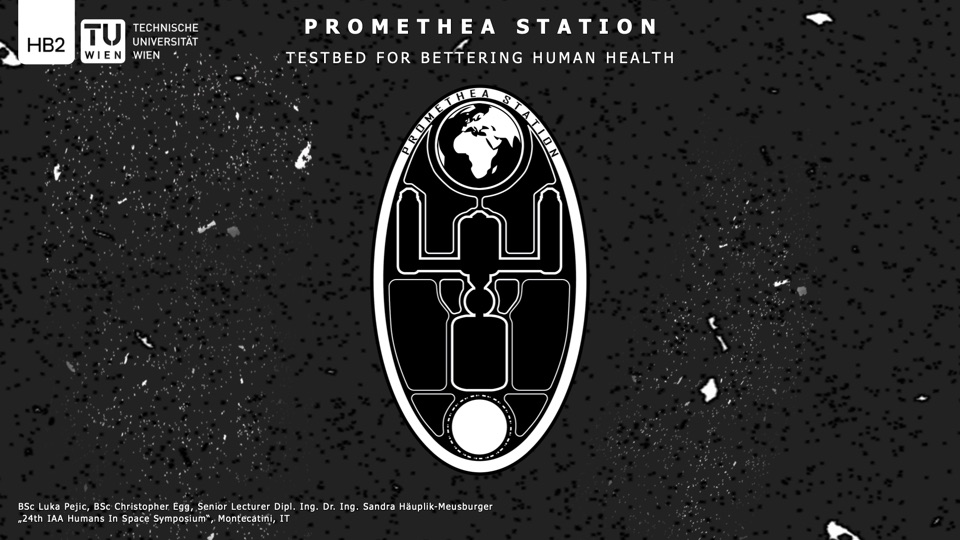 Promethea Station — 24th IAA Humans in Space Symposium
A presentation of Promethea Station at the 24th IAA Humans in Space Symposium.
-
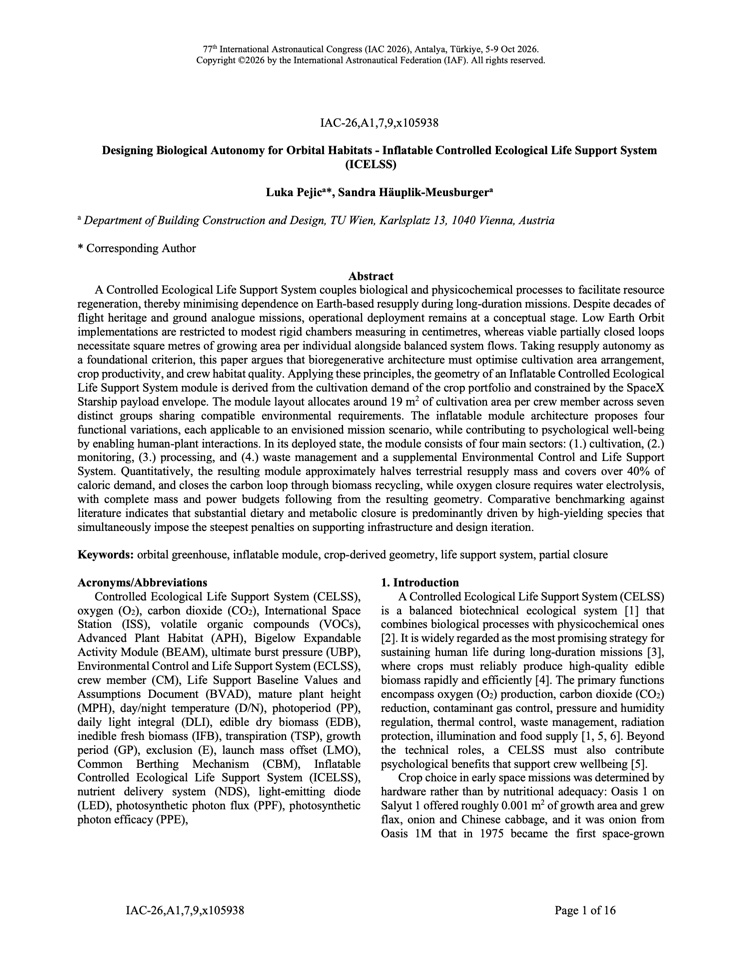 Designing Biological Autonomy for Orbital Habitats – ICELSS
ICELSS: an inflatable controlled ecological life support system for orbital habitats, linking crop yield, spatial configuration and crew experience.
-
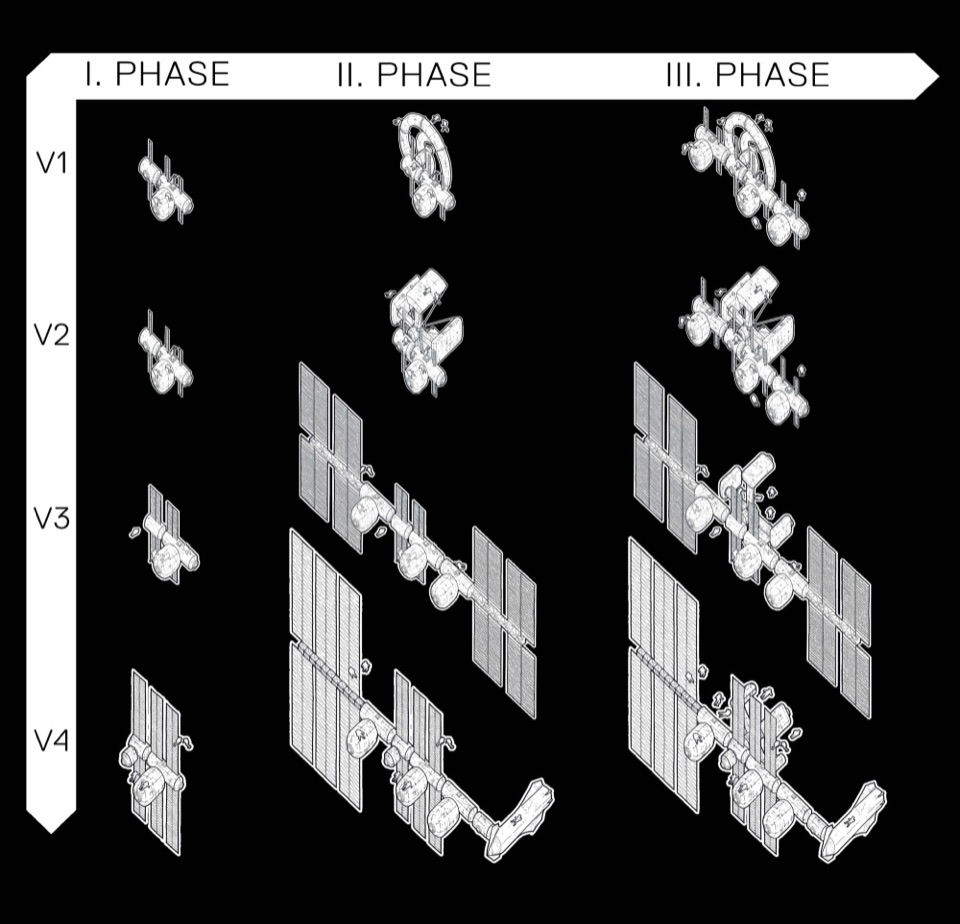 Promethea Station
A successor to the ISS, built to validate artificial gravity and closed-loop life support.